

Practice this week’s math facts, without a stopwatch
Practice the 7s multiplication factsMath facts: + and − within 20
Addition and subtraction facts in the early grades, multiplication facts from 3rd grade: take a photo of the planner line and Kamelo turns it into about ten minutes of practice. Your child answers on a big keypad, with no timer and no leaderboard.
From the photo to the practice
-
Take a photo of the planner line
“Practice the 7s,” “facts within 20,” “×6 and ×8 quiz Friday”: handwritten or printed, Kamelo works out which facts are meant.
-
Check the facts
About thirty seconds later, you see what Kamelo understood, for example the 7s with ×7 ticked. Add or remove a table with a tap, then confirm.
-
Hand over the phone
Your child finds the facts in today’s homework and practices them with Kamelo, who turns yellow for math.
During the session
- One fact at a time
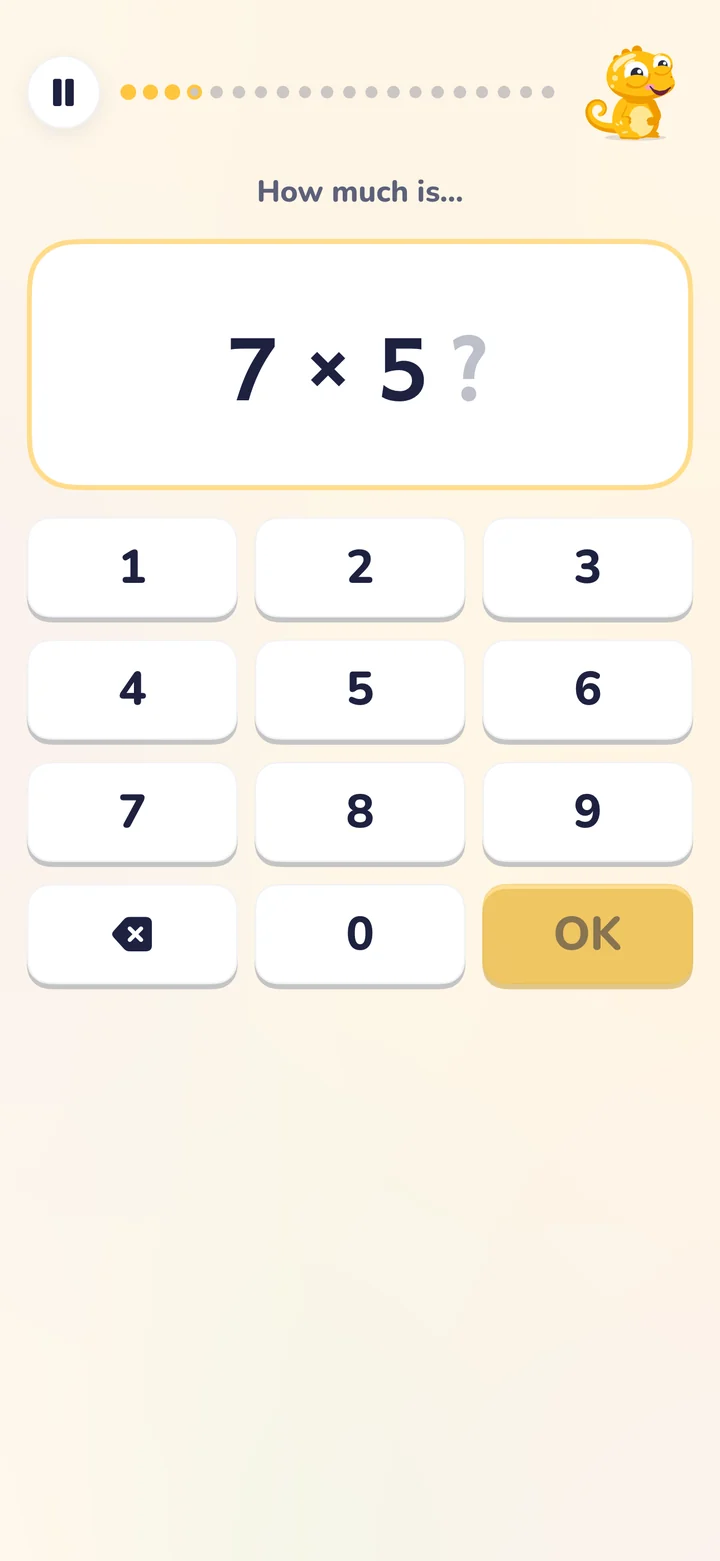
- A big card shows the fact, “7 × 5 = ?”. Your child types the answer on a large keypad or, in touch mode, taps one of four big answer bubbles.
- The whole set, mixed
- For the 7s, that’s 7 × 1 up to 7 × 10, plus the matching division facts if the teacher asked for them. For addition, 3 + 4 and 4 + 3 count as two facts, and the same fact never comes up twice in a row.
- Missed facts come back
- A missed fact is just an “almost,” with no red cross. It comes back three questions later, at most twice in a session, and your summary lists it under the facts to review.
- No timer by default
- There’s no stopwatch by default and never a leaderboard. Your child works at their own pace and hears encouragement, not a buzzer.
- Mental math too
- Make-10 facts, doubles, halves, adding tens: when the planner says “mental math,” Kamelo has an exercise for that as well.
How to help your child learn math facts at home
-
Strategies before speed
Working a fact out comes first: 9 + 6 is 10 + 5, and 7 × 4 is 7 × 2 doubled. Speed follows once the strategy is easy, and a 2021 federal practice guide says as much for timed practice.
-
A small set at a time
Work on one table or one group of facts, mixed with a few your child already knows. Move on when it’s solid, even if the week isn’t over.
-
Ask for the whole fact
Have your child say “seven times eight is fifty-six,” not just “fifty-six.” It keeps the question and the answer together.
-
A few minutes, most days
Short practice spread across the week holds up better than one long session. Spacing practice out is one of the study recommendations from the U.S. Department of Education’s research arm.
-
Know what the standards expect
Under the Common Core, which many states adopted or adapted, children should “know from memory all sums of two one-digit numbers” by the end of 2nd grade, and “all products of two one-digit numbers” by the end of 3rd grade. Our guide to math fact fluency by grade covers every grade. Common Core State Standards for Mathematics, 2.OA.B.2 and 3.OA.C.7. © Copyright 2010. National Governors Association Center for Best Practices and Council of Chief State School Officers. All rights reserved.
Questions parents ask
What math facts should my child know in each grade?
Is there an app for math facts practice without timers?
Does Kamelo do addition and subtraction facts too?
Should my child practice math facts with a timer?
How long should math facts practice take?
Official sources
- Common Core State Standards for Mathematics (PDF) (National Governors Association Center for Best Practices and Council of Chief State School Officers)
- Common Core, Grade 3: Operations and Algebraic Thinking (National Governors Association Center for Best Practices and Council of Chief State School Officers)
- Assisting Students Struggling with Mathematics: Response to Intervention (RtI) for Elementary and Middle Schools (practice guide, 2009) (What Works Clearinghouse, Institute of Education Sciences, U.S. Department of Education)
- Assisting Students Struggling with Mathematics: Intervention in the Elementary Grades (practice guide, 2021) (What Works Clearinghouse, Institute of Education Sciences, U.S. Department of Education)
- Organizing Instruction and Study to Improve Student Learning (practice guide, 2007) (Institute of Education Sciences, U.S. Department of Education)
Tonight’s homework, without the fight.
Planned for the US in January 2027. France comes first, from October 2026.