

Spelling practice on this week’s list, read aloud
Spelling list 4 (purple group): because, through, favoriteSpelling test Friday!
Take a photo of the spelling list in the planner or homework folder. Kamelo reads each word aloud, your child writes it on paper, then checks it. About ten minutes a night, on exactly the words for Friday’s test.
From the photo to the practice
-
Take a photo of the list
The planner line, the weekly list from the homework folder or a screenshot from the school app. If the class works in groups, Kamelo picks up the color groups too.
-
Check the words
About thirty seconds later, you see the words Kamelo read. Fix any word with a tap, choose your child’s group, and confirm.
-
Hand over the phone
Your child finds the list in today’s homework and practices it with Kamelo, who turns blue for spelling.
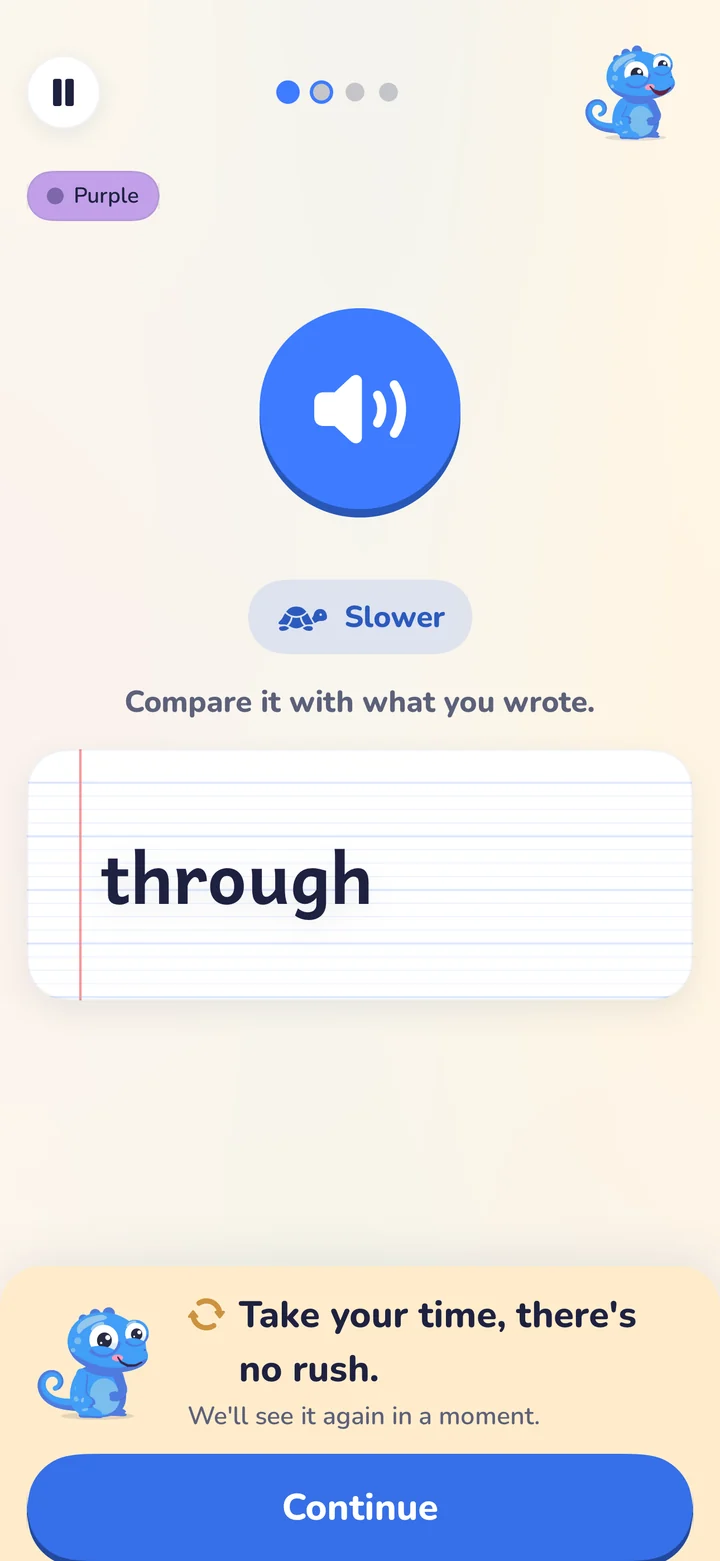
During the session
- Listen, then write on paper
- Kamelo says the word. Your child can replay it as often as needed, or tap “Slower.” They write it on paper or a whiteboard, then tap “Done! Show me.”
- Your child checks their own work
- The word appears on a lined card. Your child compares it with what they wrote and taps “Yes, got it!” or “Almost.”
- A mistake is an “almost”
- No red, and no score on screen. A word marked “almost” comes back a few words later in the same session, and tricky words get priority next time.
- A keyboard mode, if you prefer
- In the parent settings, you can switch a child to typing on a large keyboard. When the word is revealed, the letters that differ show in amber, never in red.
Try it here
Write the word in your notebook or on your whiteboard
This browser can’t read words aloud, so here’s the word written out.
Did you write it the same way?
All done!
That’s exactly what your child sees. In the app, every finished session earns colors to spend on Kamelo’s new looks.
How to practice spelling words at home
-
A few minutes on several nights
Spread the list over the week instead of cramming on Thursday night. Spacing practice out over time is one of the study recommendations from the U.S. Department of Education’s research arm.
-
Write from memory
Copying a word five times feels productive, but writing it without looking shows what’s really learned. Say the word, let your child write it, then check it together.
-
Look, say, cover, write, check
A classic routine: look at the word, say it, cover it, write it from memory, then uncover it and compare. It works with any list and needs nothing but paper.
-
Name the tricky part
In “because,” it’s the “au.” In “through,” it’s the “ough.” Pointing to the hard part gives your child one small thing to remember instead of a whole word.
-
Spend the time where it’s needed
Once a word is right two nights in a row, set it aside. Put the minutes into the two or three words that keep coming back.
-
Stop before it turns into a fight
Ten focused minutes are worth more than half an hour of arguing. If tonight isn’t working, stop and try again tomorrow. Our guide to homework fights has more ideas.
Questions parents ask
Is there an app to practice spelling words from my child’s own list?
Does Kamelo read the spelling words out loud?
What if my child’s class uses spelling groups?
Why practice spelling on paper instead of typing?
How long should spelling practice take each night?
Official sources
- Organizing Instruction and Study to Improve Student Learning (practice guide, 2007) (Institute of Education Sciences, U.S. Department of Education)
Tonight’s homework, without the fight.
Planned for the US in January 2027. France comes first, from October 2026.