

Weekly spellings, practised from your teacher’s own list
Spellings week 4 (purple group):because, through, favouriteSpelling test on Friday
Take a photo of the spelling sheet or the homework diary. Kamelo reads each word aloud, your child writes it on paper, then checks it against the word. About ten minutes, on exactly this week’s list.
From the photo to the practice
-
You photograph the list
The spelling sheet, the homework diary or a screenshot from the school app. Colour groups are recognised, so you can choose your child’s group.
-
You check the words
About thirty seconds later you see the words Kamelo read. Tap any word to correct it, then confirm.
-
Your child practises
Today’s homework is waiting on their screen: each word is read aloud, written on paper, then checked.
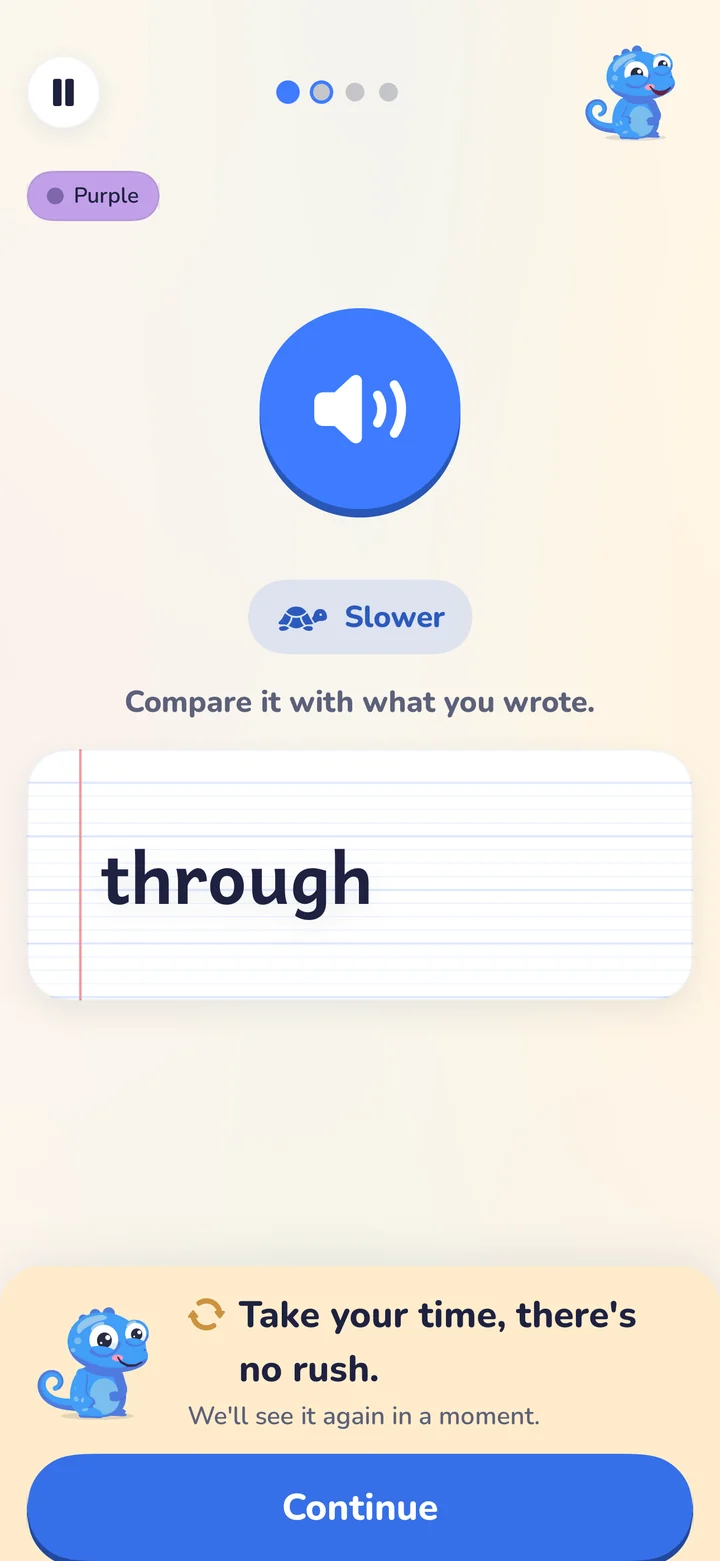
During the session
- Paper mode by default
- Your child hears the word, writes it on paper or a mini whiteboard, taps ‘Done! Show me’ and compares. They decide for themselves: ‘Yes, got it!’ or ‘Almost’.
- Listen again, or slower
- The word can be played as often as needed, and a ‘Slower’ button says it again more slowly.
- An ‘almost’ comes back
- A word your child didn’t get returns a few words later in the same session, at most twice. Nothing is ever marked in red.
- A keyboard mode, if you prefer
- You can switch your child to typing on a large on-screen keyboard. Kamelo then shows which letters matched, in green and amber.
Try it here
Write the word on paper or on your whiteboard
This browser can’t read words aloud, so here is the word written out.
Did you write it the same way?
Spellings finished!
That is exactly what your child sees. In the app, every finished session earns colours to spend on Kamelo’s looks.
Helping with spellings at home, with or without an app
-
Little and often
A few minutes on several evenings gives each word more goes than one long session the night before the test.
-
Look, say, cover, write, check
Look at the word, say it, cover it, write it from memory, then check it. Our guide to the method shows how to run it at home.
-
Say the tricky part out loud
For words like Wednesday or February, saying them as they are spelt (‘Wed-nes-day’, ‘Feb-ru-ary’) helps the silent letters stick.
-
Put the word in a sentence
Knowing what a word means and using it once in a sentence of their own makes it easier for your child to remember.
-
Keep Friday’s test in proportion
The test shows the teacher what to go over again. An ‘almost’ this week is fine: the word will come round again.
Questions parents ask
Is there an app to practise weekly spellings?
How can I help my child learn their spellings?
Does my child write on paper or on the screen?
What about spelling lists split into colour groups?
What are common exception words?
Official sources
- National curriculum in England: English programmes of study (Department for Education)
- English Appendix 1: Spelling (Department for Education)
Tonight’s homework, without the fight.
Planned for the UK in January 2027. France comes first, from October 2026.